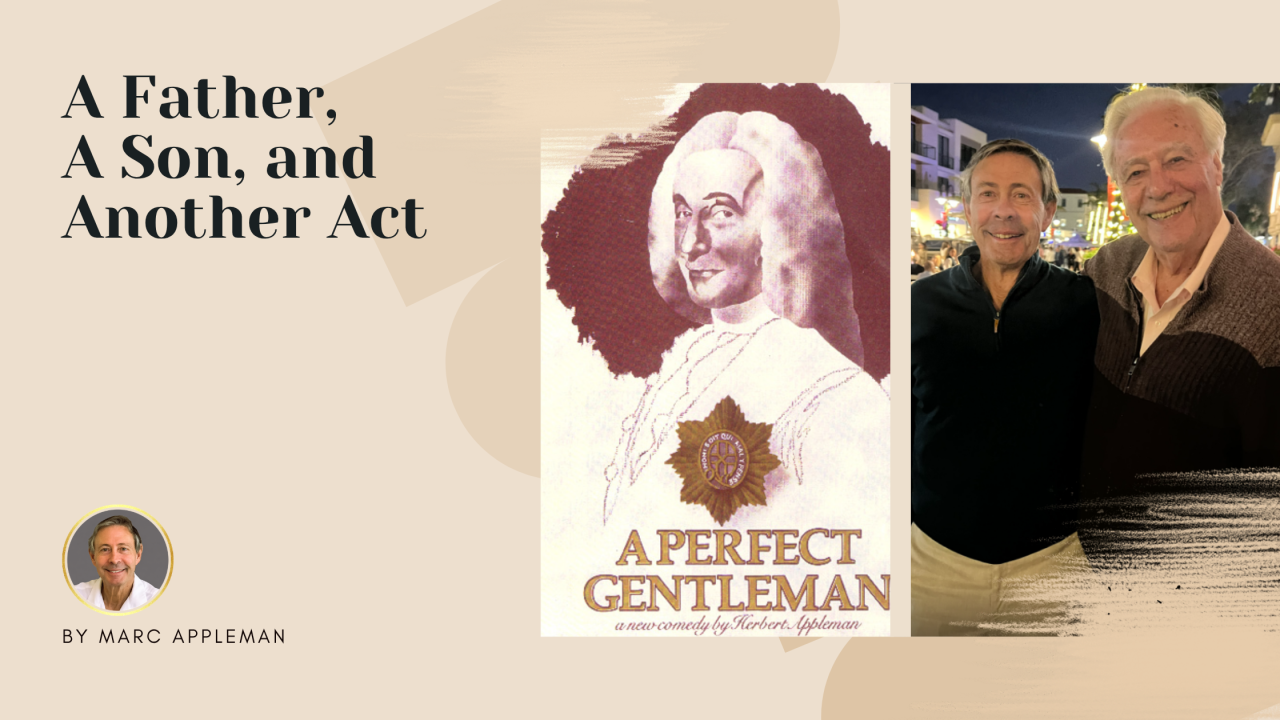
I’ve sat in theaters across England, at the Walnut Street Theatre in Philadelphia and at the Kansas City Repertory Theatre, watching my father’s play come to life.
And no matter how many times I’ve seen it, something strange happens.
I laugh.
I laugh at the same lines. I enjoy the same characters and wonderfully clever exchanges. I know what’s coming, and somehow that doesn’t matter.
And then, toward the end, something changes.
The humor gives way to something more emotional.
And I’m in tears.
I’ve seen A Perfect Gentleman enough times that I know the play almost by heart. But I never seem to know exactly what is going to happen to me.
Maybe that’s because I’m not just watching a play.
I’m watching something my father wrote.
And I’m watching it as his son.
My father, Herbert Appleman, has spent much of his life around words and theater. He is a playwright, lyricist and composer, author, documentary writer and producer, and professor of English. He has written five plays and four musicals, with his work produced throughout the United States and England. A Perfect Gentleman won the American Playwrights Theater Award.
But of all his work, A Perfect Gentleman has always felt different to me.
Perhaps because, at its heart, it is a story I understand.
A father. A son. And a lot of love.
The play is set in London in 1755.
Lord Chesterfield, the celebrated English statesman and wit, has ambitious plans for his illegitimate son, Philip. Philip has very different ideas about what he wants his life to be.
That is the setup.
But the play isn’t really about 1755.
It’s about fathers and sons.
It’s about the expectations we place on the people we love. About wanting your child to succeed — sometimes on your terms rather than theirs. About trying to please a parent while still becoming your own person.
And it is about love.
My father discovered Lord Chesterfield’s Letters to His Son when he was an undergraduate. He initially thought Chesterfield was selfish and unfeeling, putting terrible pressure on his son.
Then my father married and had a son.
He read the letters again.
This time, he found himself sympathizing with Chesterfield. He could identify with both the father and the son. He realized that Chesterfield wasn’t simply a demanding father. He was a father who loved his son.
That realization became the heart of the play.
And there is something wonderfully circular about it.
My father wrote a play about a father trying to understand his son.
And now, as a father of two sons myself, I see parts of my father in ways I couldn’t have understood when I first watched the play.
He wanted to write a play with elegant language, wit and beautiful surroundings, while exploring values he felt were being lost — compromise, imperfection, and the possibility of conflict without destroying affection.
And that’s part of what makes the play work for me.
The world of the play may be centuries away.
The emotions aren’t.
You don’t have to know anything about 18th-century London to understand a father who thinks he knows what is best for his son. Or a son who wants his father to accept him for who he is. Or the complicated ways fathers and sons express love.
That is why I think the play continues to speak to people.
It isn’t about a particular generation.
It is about every generation.
A Perfect Gentleman isn’t the only work my father has written. He has written five plays and four musicals, including Dauntless Dick Deadeye, his new version of HMS Pinafore, produced at the Open Air Theatre in Regent’s Park and nominated for an Olivier Award.
There are other works as well — some unseen for many years, and some that deserve to be discovered by audiences today.
My father is 92 now, and perhaps that is part of what has made me think differently about his work. There are plays and musicals he created decades ago that still have something to say — and I don’t want them simply to disappear into the archives.
That’s what has led me to start thinking about bringing some of his work back to the stage.
I don’t know exactly what that next chapter will look like. But I do know where I’d like to begin: with A Perfect Gentleman.
I’d like to see it in the hands of a new generation of actors and a director who can bring a fresh perspective to it without losing what makes the story so human.
And I’d like to introduce it to audiences who have never seen the play before.
If that experience is as powerful for them as it has been for me, perhaps there will be an opportunity to explore some of my father’s other plays and musicals as well.
This isn’t simply about bringing old plays back.
It’s about seeing whether something written decades ago can still have a meaningful life today.
Because I know what happens when A Perfect Gentleman is performed.
I’ve watched audiences laugh and listen. I’ve watched the mood change as the story moves toward its conclusion. And I’ve experienced that change myself, every single time.
There is something special about discovering that a story written decades ago, set in London in 1755, can still make a father and son sitting in a theater today feel something deeply personal.
Perhaps that is why A Perfect Gentleman has stayed with me.
It isn’t simply a play my father wrote.
It is part of his creative legacy — and, in a very personal way, part of mine.
I can’t help but feel there may be another chapter waiting to be written.
Thanks for reading!
I'd appreciate you sharing The Appleman Playbook with someone who enjoys looking beyond the headlines.
See you next time.
Marc Appleman.