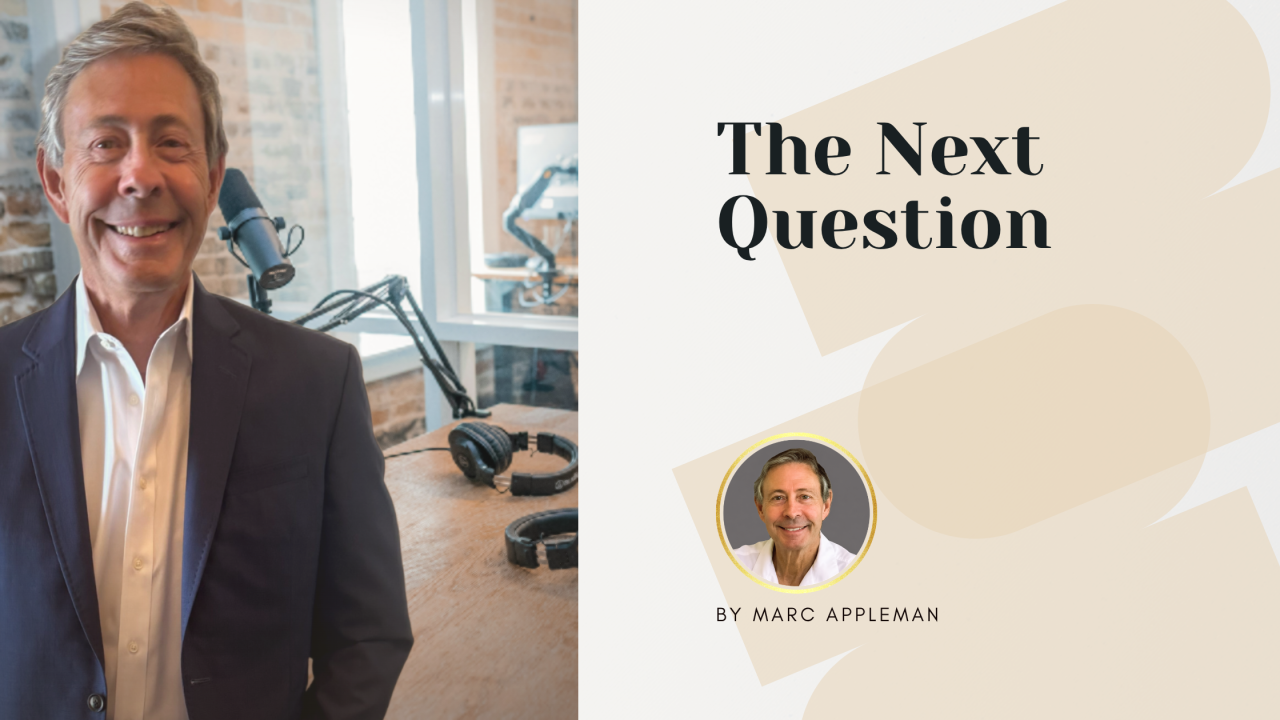
Lately, I've found myself doing more interviews again—talking with interesting people for features I've written for Naples Illustrated, as well as conversations on Pelican Bay Sports Talk. And something happened along the way: I was reminded just how much I enjoy it.
Not simply asking questions, but having a conversation that goes somewhere you didn't expect. You start with a few things you want to know, a guest says something that catches your attention, and suddenly you're asking a completely different question. Sometimes that's when you get the best story.
It got me thinking: What if I did more of this?
I've spent much of my professional life asking questions. On baseball fields, basketball courts and football fields. In television studios, on radio shows, over the phone and, more recently, on Zoom.
I've interviewed athletes, coaches, executives, entertainers and plenty of people whose names most people would recognize. I've talked with people at the beginning of their careers and others who had already reached the highest levels of their professions.
I've also spent plenty of time on the other side of the microphone, being interviewed about sports, media, business, writing and my own career.
After all those conversations, I've started thinking about a new one.
I'd like to create an interview show. I'm calling the idea The Next Question.
I don't know yet whether it belongs on television, streaming, as a podcast or as a digital video series. Maybe it could work in several of those places.
What I do know is that I don't want to create another interview show that simply moves from one predictable question to the next.
I'm interested in what happens when the conversation gets interesting.
Beyond the Expected Answer
The best interviews I've done rarely went exactly according to plan.
You can prepare 20 questions, but sometimes the answer to Question No. 3 sends the conversation in an entirely different direction.
That's when you put the list aside.
You listen.
Someone tells a story you didn't expect. An athlete talks about the person who changed his or her life rather than the championship. A CEO admits what almost went wrong. An entertainer reveals something about the journey that never makes it into the publicity material.
Those are the moments I'm looking for.
The question isn't simply, "What did you accomplish?"
It's "What did you learn along the way?"
And then comes the next question.
What Could It Look Like?
I'm imagining a few possibilities.
One could be a 30-minute conversation with one guest—an athlete, entertainer, business leader, author, entrepreneur, media executive or simply someone with a story that deserves a larger audience.
I'd be less interested in simply asking what they've accomplished than how they got there.
Who influenced them? What did they get wrong? What surprised them? What would they do differently? What do they think about differently today?
And then there's another format I'm considering:
Five Questions
Five questions designed to get beyond the obvious:
Where did you come from? What was the moment that changed you? What's something you rarely get asked? What do people misunderstand about what you do?
And finally:
What's next?
Five questions provide a framework, but the conversation can go wherever the answers take us.
Maybe one answer opens up an entirely different story. Maybe a question challenges an assumption. Maybe the guest says something neither of us expected.
That's the kind of interview I'm interested in.
Maybe It Isn't Always One Guest
Another possibility is bringing two people together—different generations, different professions or even people who disagree about something important.
A current athlete and a former athlete.
A young media entrepreneur and a veteran journalist.
A father and son.
Sometimes putting two perspectives in the same room creates a conversation neither person would have had alone.
Sports Would Be Part of It. But Not All of It.
Sports would naturally have a place.
I've spent most of my career around sports, and I still have plenty of questions about athletes, teams, technology, media and where the industry is headed.
But I don't want to make another sports interview show.
One of the things sports has taught me is that the final score is often the least interesting part of the story.
The pressure. The setbacks. The decisions. The people behind the scenes. What happens when the career ends.
Those are human stories, and they exist everywhere.
That's why I can imagine conversations that move well beyond the world of sports.
Why Now?
I've spent more than four decades watching media evolve.
I've worked in newspapers, magazines, television and digital media. I've seen audiences and technology change dramatically—and I've watched the barriers to creating and distributing media fall along the way.
But what's really prompted me to think about this now isn't simply the evolution of technology.
It's the experience of doing these interviews again.
The recent conversations I've had for Naples Illustrated and Pelican Bay Sports Talk have reminded me that the part of journalism and media I've always enjoyed most is often the simplest: sitting down with an interesting person and trying to find the story that hasn't been told yet.
And today, the opportunity to do that is greater than ever.
You don't necessarily need a network or a television studio to build an audience.
You need a compelling idea.
You need interesting people.
And you need a reason for someone to stay for the conversation.
I think The Next Question has the potential to provide all three.
The format is still evolving. What matters most to me is finding the right people and the right platform to build it with.
There is one other thing I want to make clear.
I'm open to doing individual interviews without compensation when the opportunity, subject or story makes sense. That's something I've done throughout my career and continue to enjoy.
But if we're talking about building, producing or hosting an interview show, I'm approaching that as a professional opportunity. I would expect the appropriate compensation and business arrangement to be part of the conversation.
I'm looking for the right partners, platform or production team to build something that has real value—for the audience and for everyone involved.
Where Should The Next Question Go?
If you work in television, streaming, podcasting or digital media—or know a producer, production company, network or platform that might be interested—I’d love to hear from you.
I'm also open to joining an existing interview program or working with the right people to develop something new.
Now I'm asking one of my own:
What's the next question?
I have a pretty good idea where I'd like to take the conversation.
I'm looking for the right people to help me get there.