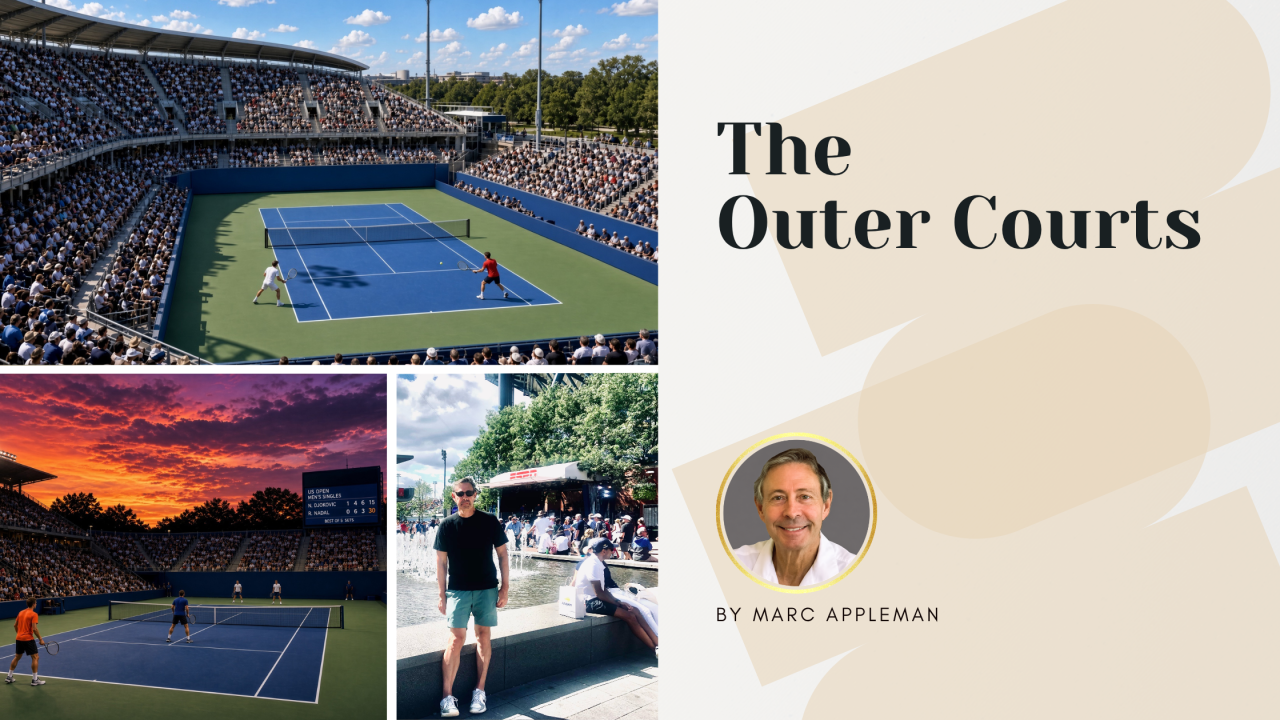
You take the train from Manhattan with thousands of other fans, walk across the bridge toward the USTA Billie Jean King National Tennis Center and feel the anticipation building before you even reach the gates.
Then you walk in—and it hits you.
The noise. The crowds. The music. The heat. The smell of food. The players moving from court to court. And somewhere in the distance, a huge roar from a crowd you can't see.
What’s happening over there?
So you start walking.
That's the US Open.
And that's what I love about it.
I'm an avid tennis player and fan, and I've been fortunate to attend some of the sport's great events—from Wimbledon and Indian Wells to Davis Cup matches and, of course, the US Open.
But I've always experienced the US Open differently.
Especially in those first few days.
You might start with a match inside Arthur Ashe Stadium, where the sheer size of the place makes a tennis match feel like a major sporting event. Then you wander over to Louis Armstrong Stadium. Maybe you catch a few games at the Grandstand.
And then you hear that roar again.
You follow it.
And suddenly you're sitting on one of the outer courts, practically on top of the action, watching two players you never planned to see.
And sometimes, those are the matches you remember.
That's what makes the outer courts so much fun. You're close enough to hear the players' shoes squeak across the court and the unmistakable pop of the ball coming off the racquet.
No television camera between you and the action.
You're right there.
And there's another part of the outer-court experience I love.
You start talking to other tennis fans.
Who have you seen? Who are you watching? Have you heard of this player? Is that kid on Court 7 someone we should remember?
You compare notes with people you've never met, and then you may go your separate ways and run into each other again an hour later.
That's part of the fun.
Television tells you which matches matter.
Being at the Open lets you discover which ones matter to you—and then talk about them with other people who are just as into tennis as you are.
Over the years, I've watched some of the game's greatest players: Pete Sampras, Andre Agassi, John McEnroe, Roger Federer, Novak Djokovic, Rafael Nadal, Andy Murray, Carlos Alcaraz, Steffi Graf, Martina Navratilova, Serena Williams, Venus Williams—and many more.
But some of the most fun has been watching players before they became stars.
I saw Coco Gauff and Frances Tiafoe when they were getting started.
I watched Emma Raducanu during her remarkable 2021 run and Ben Shelton a couple of years ago.
There's something special about seeing a young player before you know exactly how the story is going to unfold.
You watch a few games and think: Is this someone I'm going to be watching for a long time?
Sometimes you are right.
And that's the beauty of the outer courts.
In recent years, I've also enjoyed watching players warm up before their matches or practice on their days off.
You can be just a few feet away from someone you've watched on television for years.
No crowd.
No scoreboard.
No points that count.
Just the repetition. The concentration. The preparation.
A great player can turn repetition into an art form.
And then, inevitably, you start looking around again.
What's happening on the next court?
One of the most fun matches I watched as a fan came in 2016, when John McEnroe teamed with his brother Patrick in a Champions Invitational legends match against Henri Leconte and Jimmy Arias.
It wasn't a Grand Slam match. There were no ranking points at stake.
It didn't matter.
It was pure US Open entertainment.
McEnroe was McEnroe. Leconte was Leconte. The personalities were as entertaining as the tennis, and the crowd loved every minute of it.
It was exactly the kind of match you probably wouldn't have planned to see.
You just happened to be there.
And then there is the uniquely crazy rhythm of the US Open.
I've watched matches in the middle of the afternoon, when New York is hot and humid and the players are battling the conditions as much as each other.
You sit in the sun. You sweat. You drink something cold. You watch a five-set match unfold.
Then the sun goes down.
The lights come on.
And the tournament somehow gets louder.
There is something magical about being at the US Open after midnight.
The city outside is winding down, but inside the gates, the tournament is still going.
The lights are blazing. The crowd is still loud. Fans are walking around with food and drinks, trying to decide whether to stay for another match.
You look at your watch and it's 12:30.
Then 1:00.
Maybe even later.
And nobody seems to care.
That's when the US Open feels most like New York.
It's loud, unpredictable and a little crazy.
And the fans are a huge part of it.
There is nothing quite like a US Open crowd. Knowledgeable, emotional, funny, loud and never shy about expressing an opinion.
A great point can explode into an enormous roar. A disputed call can bring an entirely different reaction.
And then there's the food and drink.
The Honey Deuce has become almost as recognizable as the tennis itself. But I've also enjoyed working my way through some of the other offerings, including the Watermelon Slice and Ace Paloma.
Because at the US Open, you're not just watching tennis.
You're spending the day—or sometimes most of the night—inside a giant New York sporting carnival.
For more than two weeks, the USTA Billie Jean King National Tennis Center becomes its own little city.
And New York becomes the tennis capital of the world.
After all these years around sports—as a journalist, executive, writer and fan—I still love walking through those gates without knowing exactly what the day will bring.
Maybe a superstar on Ashe.
Maybe a great match on an outer court.
Maybe a young player I'll be watching for years to come.
Sometimes the best part of the US Open is simply seeing where the day takes you.
Thanks for reading!
I'd appreciate you sharing The Appleman Playbook with someone who enjoys looking beyond the headlines.
See you next time.
Marc Appleman.
P.S.: I advise sports and media organizations on growth, partnerships, audience strategy, and what comes next. I’m also available for keynotes and executive workshops. Feel free to reach out!