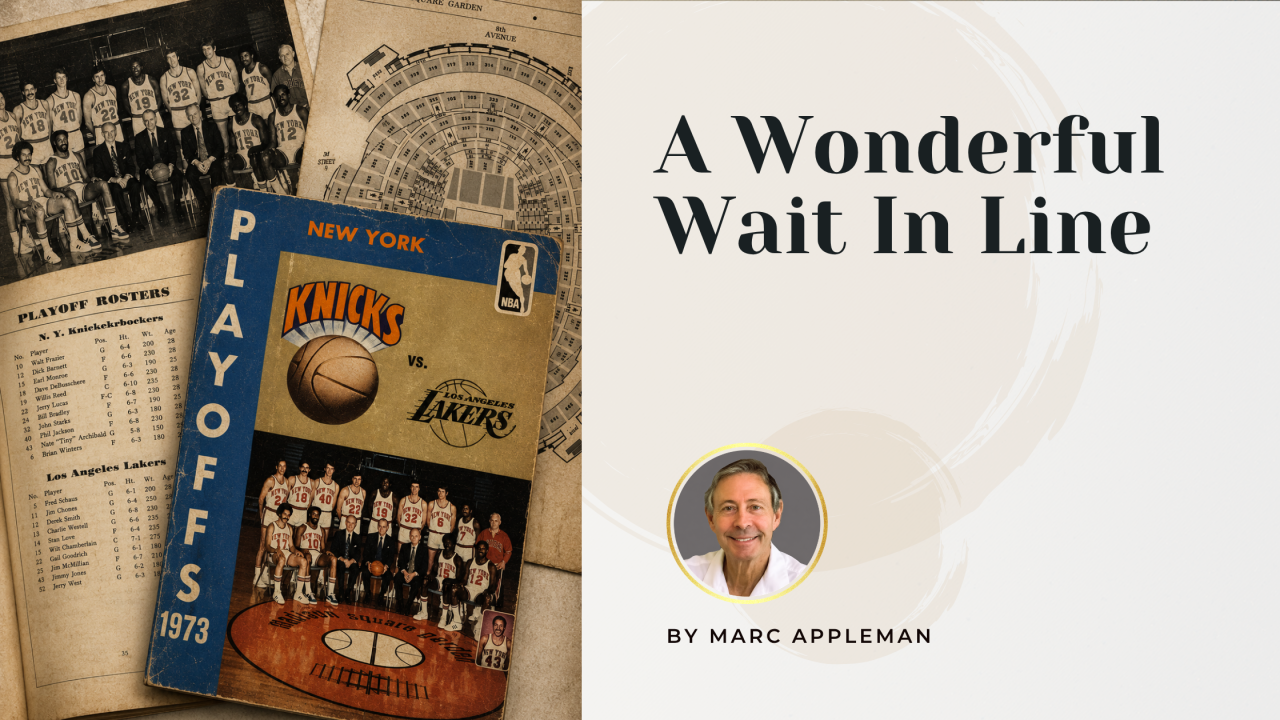
For 53 years, New York Knicks fans waited.
We endured championship droughts, heartbreaking losses, rebuilding projects, questionable trades, and the annual promise that next year would be different. Generations of fans held onto memories of Walt Frazier, Willis Reed, Bill Bradley, Dave DeBusschere, and Earl Monroe—the team that last brought New York an NBA championship.
As I watched the Knicks finally reach the top again, I found myself thinking about a very different wait. Not 53 years. Just one unforgettable night in March 1973.
I was 15 years old when I arrived at West 34th Street and walked toward Madison Square Garden, determined to spend the night on a Manhattan sidewalk for the chance to buy playoff tickets.
Today, buying tickets means opening an app, joining a virtual queue, and hoping you're selected. Back then, there were no apps, no online waiting rooms, and no digital barcodes. If you wanted playoff tickets, you showed up in person. You bundled up, brought a blanket or folding chair if you had one, and waited.
And that's exactly where I wanted to be.
Wearing a couple of sweatshirts and my "lucky" maroon pants—ugly by any reasonable standard—I joined hundreds of fellow Knicks fans on West 33rd Street. After grabbing my traditional hot dog with mustard and sauerkraut, I settled in for what I knew would be a long night.
My parents never questioned my decision. Growing up in New York City gave me enough street smarts to handle myself, and besides, I wasn't really alone. I was surrounded by people who loved the Knicks as much as I did.
Looking back, I realize we weren't simply standing in line. We were joining a community.
Complete strangers debated Red Holzman's rotations like assistant coaches. We wondered whether Willis Reed's knees would hold up through the playoffs. We talked about Walt Frazier's brilliance, Dave DeBusschere's toughness, and whether this team could recapture the magic of its 1970 championship.
Every conversation began as if we'd known each other for years.
Back then, Knicks fans didn't just watch basketball.
We lived it.
When Frazier hit a jumper, we felt like we scored. When DeBusschere battled for a rebound, our shoulders tightened with his. Bill Bradley seemed to run so relentlessly that your own legs ached just watching him sprint from baseline to baseline.
We didn't think of ourselves as customers. We were participants.
Like so many kids growing up in New York, my connection to the Knicks had started with my father taking me to my first game during Bill Bradley's rookie season. From that night on, I was hooked.
I'd been saving babysitting money for months in anticipation of the playoffs. Living in a Manhattan apartment building with around 600 families has its advantages. . There was always another babysitting job, and every dollar I earned had one destination: Knicks playoff tickets.
As the hours passed, the line became its own little neighborhood.
People shared food, traded stories, laughed, argued about basketball, and tried to stay warm. If it was sold by a street vendor, someone was eating it. Pizza, sandwiches, doughnuts, pretzels, coffee, and Cokes fueled one of the most enthusiastic gatherings of sports fans I've ever experienced.
New York truly never sleeps. Through the night, taxis rolled by, delivery trucks rumbled through the streets, and subway riders came and went while we remained in place, united by the hope that we'd soon be inside Madison Square Garden cheering our team.
However, as it got late into the night, the mood changed.
The crowds grew larger. More people tried to squeeze into the line. Tempers occasionally flared, and what had begun as a celebration of fandom became increasingly chaotic. The ticket sale would later generate controversy over crowd control and the way tickets were distributed.
But standing there as a 15-year-old, none of that mattered to me. I had one thought. Please let there still be tickets when I reach the window.
Finally, early that morning, the line began to move.
One step.
Then another.
The office slowly came into view.
A few anxious minutes later, I reached the window and bought three strips of playoff tickets—in the blue seats, of course. My dad, one of my best friends, and I were going to the playoffs.
Walking away from the ticket window, I held those tickets over my head as proudly as a heavyweight champion holding a title belt. Before I even reached the subway, ticket scalpers were making offers.
Not a chance.
Those tickets weren't for sale.
They represented months of anticipation, one unforgettable night, and the chance to be part of something much bigger than a basketball game.
The Knicks rewarded our faith. They defeated the Baltimore Bullets, survived an epic seven-game Eastern Conference Finals against the Boston Celtics, and then beat the Los Angeles Lakers to win the NBA championship.
Looking back more than five decades later, I realize I wasn't simply waiting in line for basketball tickets.
I was learning what sports can mean.
They create communities long before the opening tip.
They give us stories we'll tell for the rest of our lives.
Today's fans can buy tickets with a few taps on their phones. It's undeniably easier. But I'm grateful I grew up in a time when getting into the game required more than clicking a button.
It required patience, optimism, a pair of lucky maroon pants, a hot dog with mustard and sauerkraut, and one wonderful wait in line.
I got the tickets.
More importantly, I got a memory that has lasted a lifetime.
Thanks for reading!
I'd appreciate you sharing The Appleman Playbook with someone who enjoys looking beyond the headlines.
See you next time.
Marc Appleman.
P.S.: I advise sports and media organizations on growth, partnerships, audience strategy, and what comes next. I’m also available for keynotes and executive workshops. Feel free to reach out!